You’ve dialed in your feed speed. Your banding is straight. Your machine is running clean. But somewhere down the line, a few days, a few weeks, maybe after a customer delivery, the edge starts lifting. The joint doesn’t look right. A panel comes back.
Sound familiar?
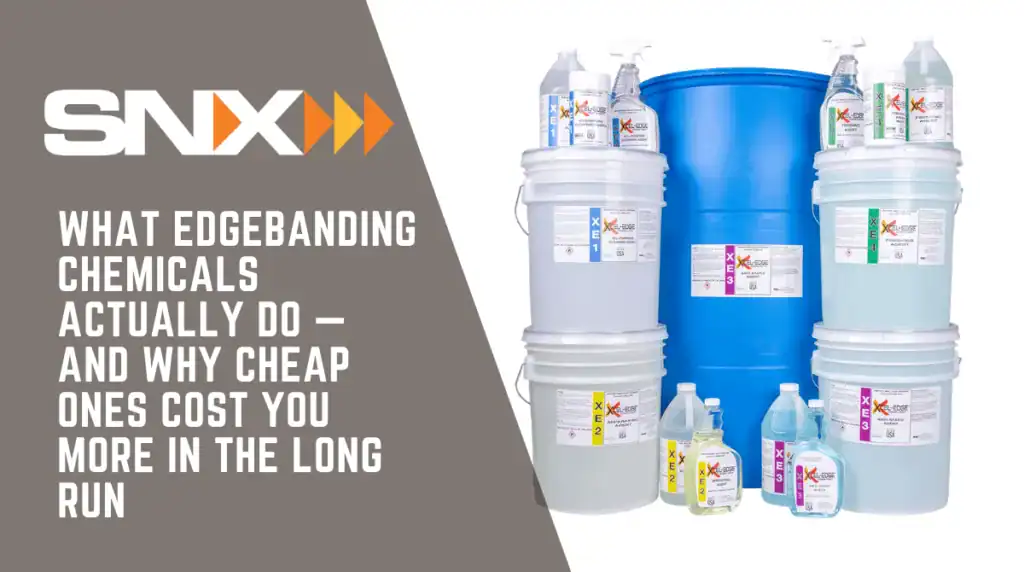
For many woodworking and cabinet shops, the frustration isn’t the machine. It’s what’s going on in it. Edgebanding chemicals are among the most overlooked variables in a production environment, yet they have an outsized impact on output quality, machine health, and long-term operating costs. This article breaks down exactly what these chemicals do, what separates quality products from cheap alternatives, and what that difference actually costs you on the shop floor.
What Are Edgebanding Chemicals and What Do They Actually Do?
Edgebanding chemicals are the adhesives, cleaners, and maintenance compounds that make your edgebanding process work and keep it working consistently.
Hot Melt Adhesives (EVA and PUR)
The most common edgebanding chemical is the hot-melt adhesive used to bond the edgebanding to the substrate. Two primary types dominate the market:
EVA (Ethylene Vinyl Acetate) is the standard glue used in most semi-automatic and entry-level straight-line and contour edgebanders. It melts quickly, applies cleanly, and works well in controlled environments. It’s temperature-sensitive, though, meaning performance can vary based on shop conditions, substrate type, and open time.
PUR (Polyurethane Reactive) adhesive creates a moisture-cured, chemically cross-linked bond that is significantly stronger and more resistant to heat, humidity, and stress. PUR is increasingly popular in high-demand cabinet and furniture production environments where joints must withstand real-world conditions.
Choosing the right adhesive type and the right quality within that type directly affects bond strength, open time, stringing, and how cleanly the adhesive releases from your glue pot.
Cleaning and Maintenance Chemicals
Beyond adhesives, edgebanding chemicals include:
- Glue pot cleaners that dissolve adhesive buildup without damaging Teflon-coated or stainless surfaces
- Application rollers and pressure pad cleaners that maintain consistent glue transfer
- Pre-treatment primers for difficult substrates like certain laminates or powder-coated surfaces
- Release agents that prevent adhesive from sticking where it shouldn’t
Each of these plays a role in keeping your machine running at spec and your output consistent from the first panel of the day to the last.
Why Cheap Edgebanding Chemicals Cost You More Than You Think
It’s tempting to save money on consumables, especially when margins are tight. But there’s a significant difference between being cost-smart and being cost-blind, and cheap edgebanding chemicals often fall into the second category.
The Hidden Cost of Poor Bond Strength
Low-quality adhesives frequently show their weaknesses after the part leaves your shop. Bond failures due to inferior EVA formulations or off-spec melt temperatures lead to warranty callbacks, rework, and loss of customer confidence. Those costs rarely show up on a single line item, but they add up quickly.
A higher-quality adhesive that bonds cleanly the first time, every time, eliminates the downstream cost of fixing what should have been right from the start.
Machine Wear and Glue Pot Damage
Inferior adhesives often contain fillers or inconsistent polymer blends that leave behind more residue, char faster in the pot, and string excessively. This creates buildup that requires more frequent cleaning, increases maintenance downtime, and, over time, degrades the performance of your glue application system.
If you’re using a machine like the SNX nVision contour edgebander, which features a Teflon-coated 1kg glue pot designed for ease of glue changeover and cleaning, using a poor-quality adhesive runs counter to everything the design is built for. Quality edgebanding chemicals protect your equipment investment.
Inconsistent Viscosity and Open Time
Budget adhesives are often inconsistently formulated. That means your melt temperature, viscosity, and open time can vary batch to batch, even within the same brand. In a production environment, that variability translates directly into inconsistent joint quality and wasted material.
Consistent edgebanding chemicals give your machine something predictable to work with, which is how you get consistent output at volume.
Downtime Is Always More Expensive Than Better Chemicals
Every time a glue pot needs emergency cleaning, a part needs rework, or your machine requires an unscheduled service call, you’re paying in time and throughput, not just materials. The real cost of cheap edgebanding chemicals isn’t what you paid for them. It’s what you lost while your machine was out of spec or your team was fixing problems that should never have happened.
How to Choose the Right Edgebanding Chemicals for Your Operation
Not every shop has the same needs. Here’s a practical framework for choosing the right products.
Match Adhesive Type to Your Application
For most shops running standard cabinet and furniture panels with PVC or ABS banding, a high-quality EVA adhesive will perform well when applied at the correct temperature and on properly prepared substrates.
For shops producing high-end cabinetry, exterior components, or parts that will be exposed to moisture and temperature fluctuations, PUR adhesive is worth the additional investment. The bond quality difference is measurable.
Consider Your Substrate and Banding Material
Different substrate types, such as MDF, particleboard, solid wood, and certain laminates, respond differently to adhesives. Similarly, the banding material itself (PVC, ABS, wood veneer, HPL) affects which adhesive chemistry performs best. Quality chemical suppliers will provide guidance on these pairings.
Don’t Neglect Cleaning Products
Glue pot life and machine performance are directly tied to cleaning discipline. Using the right cleaning compounds at the right intervals keeps your machine running closer to spec for longer. This is especially important in high-production environments where the glue pot is rarely fully emptied between shifts.
For guidance on edgebanding machine maintenance best practices, resources like the Wood Machinery Manufacturers of America (WMMA) provide industry-standard guidance that complements manufacturer recommendations.
The Connection Between Chemicals and Machine Performance
It’s worth stating clearly: your edgebanding machine and your edgebanding chemicals are a system. Optimizing one while neglecting the other limits the performance of both.
The SNX nVision is engineered for consistency, from its patented 3-axis floating laser system that guarantees tight butt joints to its UL 508A-certified electrical panel and enclosed pneumatic cabinet. That engineering precision is best realized when paired with chemicals that are equally consistent and appropriate for the application.
Matching your chemical selection to your machine type, your production volume, and your material mix is how you get the most from both. If you’re unsure what that looks like for your setup, it’s worth having a conversation with someone who understands both sides of the equation.
For a deeper look at how edgebanding equipment is evaluated and specified, the Woodworking Network is a trusted industry resource used by cabinet and furniture manufacturers across North America.
And if you’re evaluating your overall finishing workflow, not just edgebanding, but how parts are handled, held, and processed, the SNX PuckerStand PS-1 flexible parts-finishing station is worth exploring. It’s designed to keep parts secure and accessible during hand-routing, scraping, and cleaning operations, which complements a well-run edgebanding line.
A Note on Chemical Safety and Handling
Quality edgebanding chemicals come with proper safety data sheets (SDS), clear temperature and application guidelines, and documented shelf life. If your current supplier can’t readily provide that information, that’s a meaningful signal about product quality and supply chain accountability.
Adhesives applied at incorrect temperatures, often due to inconsistent formulations, also pose unnecessary health and safety risks in the shop. Proper chemical selection is part of running a safe and compliant operation.
Ready to Get More From Your Edgebanding Operation?
If you’re investing in quality equipment, it makes sense to be equally intentional about the chemicals running through it. The difference between good edgebanding and great edgebanding often comes down to the consumables and the knowledge behind choosing them correctly.
At SNX Technologies, we work with woodworking and cabinet shops to help them get the most from their equipment and production processes. Whether you have questions about machine-chemical compatibility, want to learn more about the SNX nVision contour edgebander, or are simply looking for a trusted resource in the industry, we’re here to help.
Contact the SNX Technologies team to talk through your edgebanding operation — no pressure, just practical guidance from people who understand production environments.