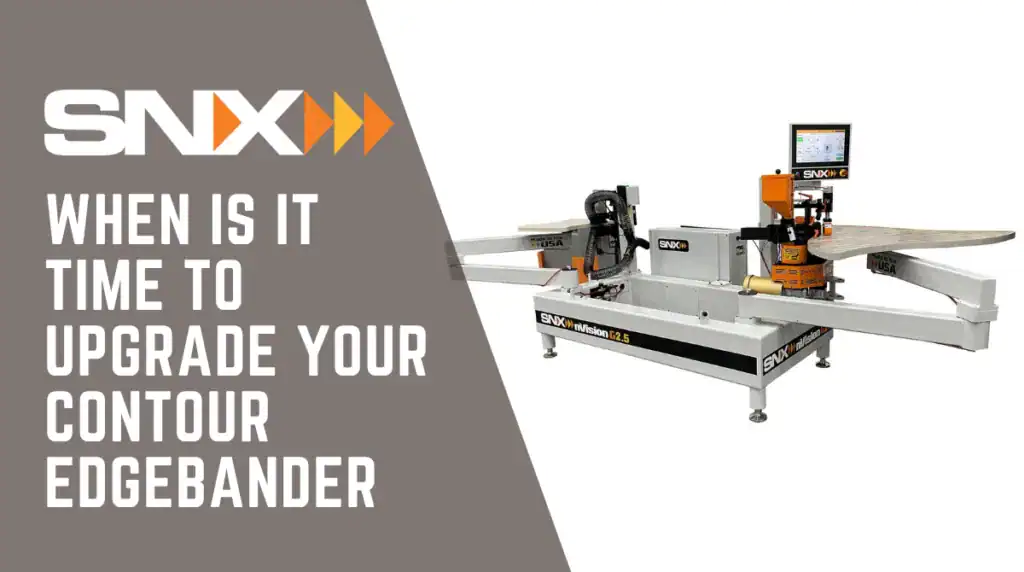
If you’re weighing whether to upgrade or replace your contour edgebander, you’re not alone. Most cabinet, closet, and millwork shops eventually reach the same fork in the road: the current machine still runs, but it’s starting to hold back production. Before you commit to a big capital purchase, it helps to separate this into three distinct paths: upgrade, trade in, or fully replace your edgebander, and match the right one to where your shop actually is today.
Signs the Question Is Worth Asking
A contour edgebander rarely fails all at once. Instead, shops usually notice a slow build-up of small frictions: more manual touch-up after banding, a controller that no longer gets software updates, a shrinking pool of parts for an older model, or a part geometry the current machine simply can’t trim. Any one of those is a reason to start comparing your options. Several of them together usually mean it’s time to decide between an upgrade or replace situation rather than keep patching the same machine.
Three Paths, Side by Side
| Option | Best For | Typical Cost | What You Keep |
|---|---|---|---|
| Upgrade | A machine that’s structurally sound but limited by an older control or tooling setup | Lowest, a fraction of a new machine | Your existing frame, footprint, and crew’s familiarity with it |
| Trade In | A working machine you’re ready to move on from before it loses more value | Moderate, offset by your machine’s trade value | A cleaner transition with less idle time between machines |
| Replace | A machine that’s become a bottleneck, unreliable, or unsafe to keep running | Highest upfront, lowest cost per part over time | A clean start with current controls, tooling, and support |
How to Decide Between Upgrade or Replace
A useful starting rule from the broader manufacturing world: if the cost to fix or upgrade a machine climbs past roughly half of what a new one would cost, replacement usually wins on total cost of ownership, not just the price tag today. That said, the number on the repair invoice is only part of the picture. Also weigh downtime, since a fast upgrade might sideline your line for days while a full replacement could mean weeks between old machine removal and new machine installation. Factor in your team’s learning curve too. A retrofit or upgrade on a familiar machine usually requires far less retraining than a brand-new control system.
The Financing and Tax Side
Whichever direction you lean, the way you pay for it matters. Section 179 of the federal tax code lets many businesses deduct the full cost of qualifying equipment in the year it’s placed in service, rather than spreading that deduction over several years. The specific dollar limits change from year to year, so check the current figures with your accountant before you budget a purchase, but the underlying incentive has made both upgrades and full replacements more affordable for a lot of shops than the sticker price alone suggests.
Where SNX Fits In
Every nVision contour edgebander is built to take upgrades and add on options without a full teardown, which is exactly why so many shops choose to upgrade or replace only the parts of the machine that are actually holding them back. If your current machine has reached the end of what an upgrade can fix, our team can also put its trade in value toward a new nVision, so you’re not paying full price twice. Either way, we’ll walk the specific machine and part mix with you before you commit to anything.
Ready to talk it through?
Tell us what your current edgebander is (and isn’t) doing, and we’ll help you choose the upgrade, trade-in, or replace path that actually fits your shop.