A contour edgebander asks more of its glue than a straight-line machine ever will. The banding has to bend around outside curves, tuck into tight inside radii, and hold a clean butt joint where it meets itself, often on parts that are guided through the machine by an operator rather than a conveyor. That’s why choosing the right edge banding glue for a contour edgebander isn’t just about grabbing whatever pellets are on the shelf. The wrong edging glue shows up as lifted edges on curves, visible glue lines, and parts that come back for rework.
Here’s what actually matters when you’re picking an adhesive for contour work, and how to match your glue to your parts.
Why Contour Edgebanding Is Different
On a straight-line edgebander, the panel moves at a fixed feed rate, and the edgebanding goes on flat. Contour work changes almost every one of those conditions:
- The edgebanding flexes, not just presses: Around an outside curve, the banding stretches. Into an inside radius, it compresses. The glue line has to flex with it and keep holding once the part cools.
- Radii can be extremely tight: The SNX nVision C1.5 can edgeband and trim an inside radius as small as 7/16″. The tighter the radius, the more stress sits on the bond.
- Feed rate depends on the part and the operator: Shaped parts are guided through the banding station, so speed naturally varies around corners and complex profiles. Your glue needs enough working time to handle that variation.
- Butt joints are visible: Where the banding meets itself, any excess or discolored glue is right there for the customer to see.
5 Questions to Ask Before You Choose an Edgebanding Glue
Matching Your Parts to the Right Xcel-Edge Glue
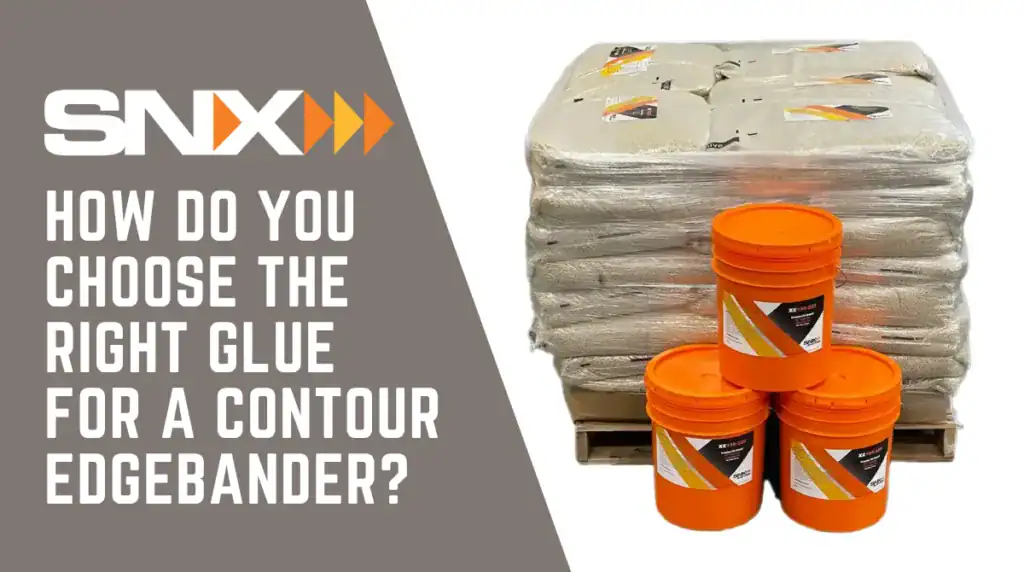
Xcel-Edge Glue is SNX’s own EVA hotmelt edging glue, developed for both straight-line and contour edgebanders. Its rubber-type formulation is built to be stronger, stickier, and stretchier, which is exactly what banding on curves demands. It comes in three formulations:
| Formulation | Application Temp | Consider It When |
|---|---|---|
| Translucent Low Temp (XE125-160) | 125°C to 160°C | You’re bonding heat-sensitive materials and want to reduce the risk of heat damage, with a glue line that blends in. Required when using. 5mm edgebanding. |
| Natural High Temp (XE190-220) | 190°C to 220°C | You want a high-temp, all-around formula for everyday banding where glue line color isn’t critical. |
| Clear High Temp (XE195-220c) | 190°C to 220°C | You need high-temp performance and a non-filled clear glue line for light colors and invisible joints. |
Not sure which way to go? Each formulation is available in a 2 lb sample, so you can run test parts on your own machine, with your own edgebanding, before committing to a 5-gallon pail or 44 lb bag. Try the high-temp sample, the natural high-temp sample, or the translucent low-temp sample.
What About PUR?
PUR adhesives offer excellent moisture and heat resistance, but they cure through a chemical reaction and require different handling than EVA, including storage and glue-pot cleaning. SNX nVision contour edgebanders are built around standard EVA hotmelt, which covers most of cabinet, furniture, and fixture work. For a deeper comparison, read EVA vs. PUR: choosing the right edgebanding adhesive.
Signs You’re Running the Wrong Glue
Red Flags on Contour Parts
- Edgebanding lifting on outside curves or pulling away from tight inside radii
- Glue lines that look dark, yellowed, or thick on light banding
- Butt joints that open up after the part cools
- Stringing or smoking at the glue pot
- Bonds that feel fine at the machine but fail days later
Any of these can also point to temperature, feed, or maintenance issues, not just the glue itself. Our guide to troubleshooting poor bonding walks through how to tell the difference.
Get More Out of Whatever Glue You Choose
Best Practices for Contour Edge Banding Glue
- Keep edgebanding warm and stable before it hits the machine. A CoilHub holds coils at a consistent temperature, which helps reduce delamination and chipping.
- Run the glue pot within the manufacturer’s rated range, and don’t overheat it trying to compensate for a cold shop.
- Use a separating agent like Xcel-Edge XE2 to keep squeeze-out from sticking to panel surfaces.
- Keep the glue pot clean and avoid mixing different glue types without a full cleanout.
- Test new edgebanding materials with a sample before running a full job.
For more on dialing in heat across the whole process, see the ultimate guide to edgebanding temperature control. For background on how edgebanding works in general, Wikipedia’s edge banding overview covers the basics of materials and application methods.
Find the Right Edging Glue for Your Contour Work
SNX designs and builds nVision contour edgebanders in Sauk Rapids, Minnesota, and developed Xcel-Edge glue for them. Tell us what edgebanding you use, what your parts look like, and where you’re seeing problems, and we’ll help you choose the right edgebanding glue for your shop.