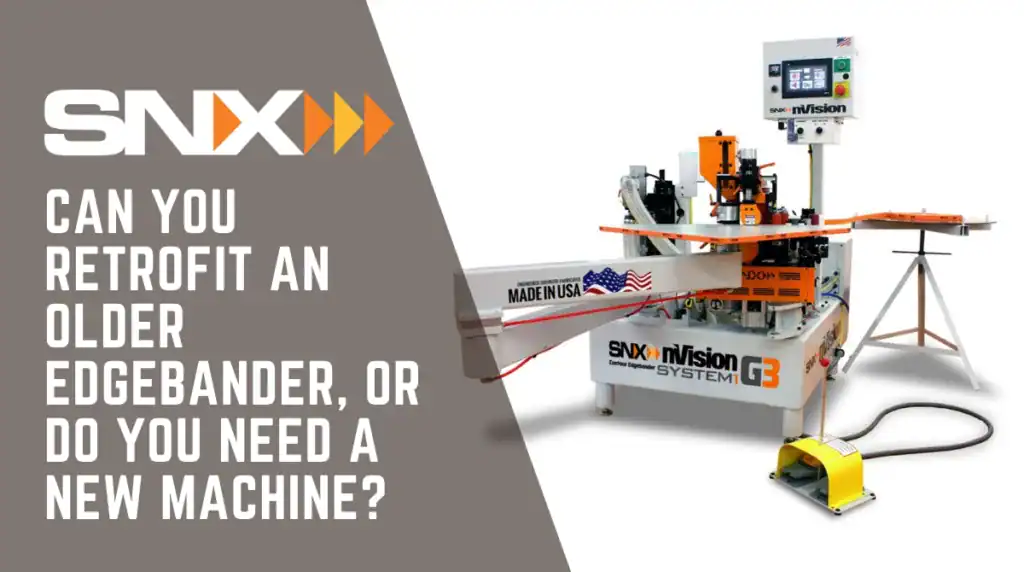
An older contour edgebander doesn’t automatically mean it’s time to buy a new one. In many cases, the right retrofit edgebander project can close the gap between what your machine does today and what your shop actually needs, without the cost or downtime of a full replacement. Over the years, SNX has developed a long list of improvements in direct response to customer feedback, and many of them are available as field retrofits to the nVision you already own. Others genuinely require a new machine. The trick is knowing which is which, so here’s the honest breakdown.
What Can Be Retrofitted in the Field
A surprising amount, can be retrofitted and we developed each of these because customers asked for it. If your machine’s frame and structure are sound, these retrofit edgebander options can upgrade your whole edgebanding department without replacing the machine itself.
Application and Trimming Quality
- New laser technology: Greater sensitivity and consistency, including reliable reading of darker colors that older sensors struggle with.
- Precision-ground aluminum pods: Substantially improved trimming consistency across every part that crosses the machine.
- Top pressure wheel with longer stroke: Switch between 1.25-inch and ¾-inch board thickness with no adjustments required, removing a constant source of operator fiddling.
- Infeed guide kit: Fully controls the height of your edgebanding as it enters the machine, so the banding lands on the panel where it’s supposed to, every time.
- Tight inside radius kit: A 3-inch wheel and extended top pressure wheel keep the panel securely positioned when edgebanding inside radii under 1.5 inches, opening up part geometries older setups couldn’t hold.
Dust, Material, and Cutting
- New 4-inch top and bottom dust hoods: At least 90 percent better chip containment than the previous 3-inch design, which your cleanup crew and your air quality will both notice.
- Heavy-duty guillotine: Added power lets you process of veneers, laminates, and stiff 3mm PVC edgebanding that a standard guillotine can’t cut cleanly.
- CoilHub-S or CoilHub-M: A dust-free, temperature-controlled environment that keeps your edgebanding at the optimal temperature before it ever reaches the machine, improving pliability and adhesion. Both pair with any nVision.
Workflow and Finishing
- Small parts tables: Support parts that are too small for the vacuum pods during edgebanding and trimming, so small-part work stops being a two-person job.
- SNX-MarBel slitter: Easily slit laminate strips or PVC edgebanding to the optimal height for your edgebander, instead of living with whatever width the supplier shipped.
- PS-1 vacuum stand: A rotatable vacuum stand ideal for finishing, inspecting, and assembling cabinets beside the machine.
- Li’l Pucker: Retire the utility knife and paint scraper for a professional hand scraper designed to deliver a perfect edge finish.
Every item on that list bolts into your existing operation. None of them require replacing the machine, and together they were designed with one goal: higher-quality work surfaces with less scrap, less rework, and less hand finishing.
What Can’t Be Retrofitted (and Why That Matters)
Some of the biggest advances in the current nVision generation live in the machine’s core systems, and you can’t add them to an older frame in the field. If these are the capabilities your shop needs, the path is a new machine or a trade-in rather than a retrofit:
- New PC controller: Significantly faster processing and more memory, a more user-friendly experience, more consistent and accurate butt joints, and support for built-in educational videos right at the machine.
- New encoder: Doubled pulse count, which translates directly into more consistent, accurate butt joints.
- New quick-change glue pot: Cuts glue pot swap time from 30 minutes to under 5, a major maintenance efficiency gain for shops that change adhesives or colors regularly.
- New collet-style spindles: 16,000 rpm motors with shank-style tooling replace the older 12,000 rpm custom cutters. The result is a better, more consistent finish, roughly 4x tooling life, and the ability to top and bottom trim a 7/16 inch inside radius.
- New servo-driven trimming unit: Improved accuracy and consistency with easier setup, which matters most when you’re training new operators.
It’s worth being clear-eyed about that second list. The controller, encoder, and spindles are where the biggest gains in joint quality, finish, and tooling cost live. A retrofit edgebander project can meaningfully upgrade an older machine, but it can’t turn last generation’s core into this generation’s.
So Which Path Is Yours?
A practical way to decide: write down the specific problems you’re trying to solve, then check which list they fall on. Dust everywhere, banding wandering on the infeed, small parts slowing you down, or inside radii you can’t hold are field-retrofit problems. Butt joints that won’t tighten up, tooling costs that keep climbing, half-hour glue changes, and a controller your newest operator finds baffling are new-machine problems.
Age and condition matter too. A retrofit makes sense when the frame and drive systems are still solid, and parts for the machine’s core platform remain available. If the structure itself is worn, or you’d be stacking multiple retrofits onto a machine that’s already fighting you, the math shifts toward replacement. Our earlier look at when it’s time to upgrade your contour edgebander walks through that cost comparison in more detail.
And if the answer is a new machine, your current one isn’t a write-off. Its trade-in value can go toward a new nVision, which is how many shops get the non-retrofittable upgrades without paying sticker price on top of a machine that still runs.
Keeping Either Path Running
Whether you retrofit or replace, uptime comes down to the same fundamentals: real parts availability and support you can actually reach. Our domestic support and parts and service team back every field retrofit kit and every new machine, so a retrofit edgebander project doesn’t leave you stranded without a source for parts down the road.
Not sure which list your problems fall on?
Send us your machine’s model and what’s actually holding it back, and we’ll tell you honestly which upgrades can be retrofitted in the field and which would require a new machine.