If you’re shopping for a wood CNC machine, you’ll run into two terms that seem to describe the same thing: CNC router and CNC machining center. Both cut, shape, and drill panels and parts under computer control. Both show up in cabinet shops, furniture plants, and fixture manufacturers. So what’s the real difference between a CNC machining center and a CNC router, and which one does your shop actually need?
The short answer is that the terms overlap more than most sales brochures admit. The longer answer comes down to capability, tooling, and the kind of parts you make. Here’s how to sort it out.
What Is a CNC Router?
A CNC router is a computer-controlled cutting machine that moves a router-style spindle over a work table. In woodworking, it’s the go-to wood CNC machine for cutting parts out of full sheets of plywood, MDF, particleboard, and plastics. A CNC router can take over the jobs of several traditional shop machines, including panel sawing, shaping, and boring.
Typical CNC router features include:
- A flat table: Usually a vacuum table sized for full sheets, often 5′ x 10′ or 4′ x 8′.
- A main spindle: Some entry-level machines use a single spindle and manual tool changes, while production routers add an automatic tool changer.
- Three-axis motion: The spindle moves left-right, front-back, and up-down to cut 2D and 2.5D profiles.
- Nested-based manufacturing: Parts are arranged, or “nested,” on the sheet to cut as many as possible with minimal waste.
What Is a CNC Machining Center?
In metalworking, “machining center” usually means a CNC milling machine with an automatic tool changer. In woodworking, the term is used for heavier-duty machines that do more than cut sheets. A CNC machining center is built to perform multiple operations on a part without moving it to another machine.
Common CNC machining center features include:
- Larger tool capacity: Bigger automatic tool changers so the machine can switch between many cutters in one program.
- Boring blocks: Multi-spindle drilling heads for fast vertical and often horizontal holes for hardware, shelf pins, and dowels.
- Extra axes: A “C” axis lets the machine rotate aggregate heads for angled drilling, sawing, and edge work. Five-axis heads can machine complex 3D shapes.
- Flexible workholding: Pod-and-rail tables hold individual parts off the table surface, so the machine can work edges and undersides, not just the top face.
- Heavier construction: Stiffer frames and bigger motors for long production runs and solid wood work.
Where the Line Gets Blurry
Here’s the honest part: many modern CNC routers now include features that used to belong only to machining centers. You can see the overlap in real machines. For example, SNX has listed a 2006 Stratos Nest CNC router with an 8-position tool changer and a 9-spindle boring block, alongside a 2007 Biesse Rover B machining center with a 12-position tool changer and a 14-spindle boring block. Both carry an HSK63F main spindle. The router is set up for nesting sheet goods, while the machining center has a larger 5′ x 20′ table and more tooling, but the difference is one of degree, not a hard line.
That’s why the name on the brochure matters less than the spec sheet. Look at what the machine can actually do and compare that to the parts you make.
CNC Router vs. CNC Machining Center at a Glance
| Typical CNC Router | Typical CNC Machining Center | |
|---|---|---|
| Main job | Cutting parts from sheet goods | Multiple operations on a part in one setup |
| Work table | Flat vacuum table for nesting | Flat table or pod-and-rail for individual parts |
| Tooling | Manual or smaller automatic tool changer | Larger tool changer, often plus aggregates |
| Drilling | Router bits or a smaller boring block | Larger boring blocks, often with horizontal drilling |
| Motion | Usually 3-axis | 3-axis plus C axis, 4-axis, or 5-axis |
| Investment | Lower | Higher, with more floor space |
| Best for | Cabinet boxes, panels, signs, flat parts | Furniture, solid wood parts, complex hardware prep |
Which Wood CNC Machine Does Your Shop Need?
A CNC Router Is Likely Enough If
- Most of your work is cutting cabinet parts or panels from full sheets
- Your drilling needs are mostly shelf pins and basic hardware holes
- You want the fastest path to nested-based manufacturing
- Floor space and budget are real constraints
A CNC Machining Center Makes Sense If
- You machine solid wood parts, furniture components, or 3D shapes
- You need horizontal drilling or edge operations without a second machine
- Your parts need work on multiple faces in a single setup
- You run long production runs where fewer handling steps save real time
Don’t Forget What Happens After the CNC
Whichever machine you choose, the parts coming off it still need finished edges. That’s easy on straight panels, but curved and shaped parts are where many shops get stuck. A straight-line edgebander can’t follow a radius, and outsourcing or hand-banding curved parts eats into the time your CNC just saved you.
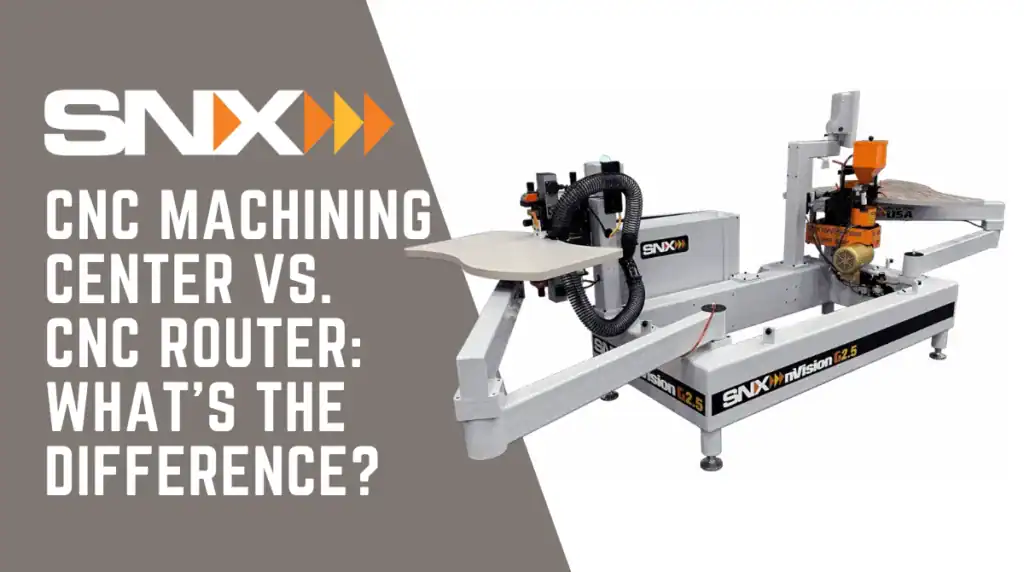
That’s the job SNX nVision contour edgebanders were built for. They edgeband and trim shaped parts with tight butt joints, handling PVC, ABS, and wood veneer tapes from .5mm to 3mm. The nVision G1.5 and G2.5 give shops a cost-effective way to band shaped parts without investing in an expensive CNC edgebanding system, and the nVision C1.5 handles inside radii as small as 7/16″. To see how bringing that work in-house pays off, read the ROI of in-house edgebanding.
Buying Used? Make Sure It’s Demo-Ready
A used CNC router or machining center can be a smart way to add capacity, as long as you know what you’re getting. SNX believes every used machine should be under power and demo-ready so you can inspect it in person before you buy. Browse current listings on our used machines page, and explore financing options for new or used equipment. Whatever you run, dependable support keeps it earning. See how domestic support improves CNC machine uptime.
Build a Smarter Panel Processing Line
Whether you’re choosing between a CNC router and a CNC machining center or figuring out how to finish the curved parts they produce, SNX can help you plan the right setup. Talk to our team about nVision contour edgebanders, used CNC equipment, and the consumables that keep your line running.